- Evolutionary prospection in Globorotalia
menardii
-
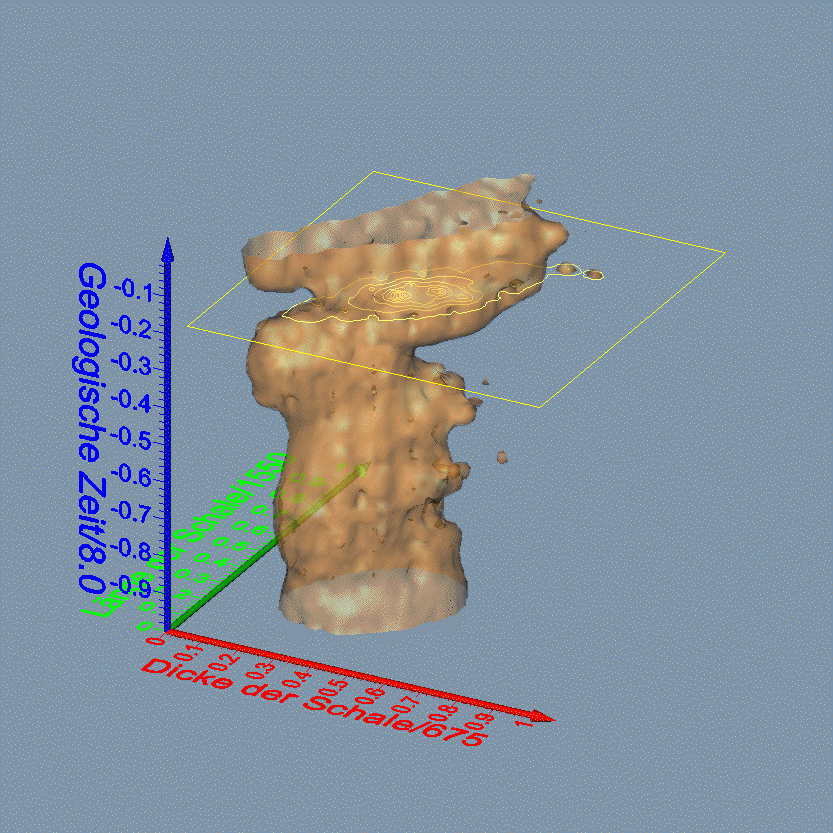 In practice we use menardiform globorotalids
for the study of evolution. In the figure to the left the low
frequency portion of the density distribution of G. menardii,
is shown for DSDP Site 502 (Caribbean Sea). Density means here
the relative number of specimens per grid-cell, whereby each
grid-cell is spanned by units in direction of the spiral height
of the shell (red axis), units in direction of the length of
the shell in axial view (green axis) and units of geological
time (blue axis).
In practice we use menardiform globorotalids
for the study of evolution. In the figure to the left the low
frequency portion of the density distribution of G. menardii,
is shown for DSDP Site 502 (Caribbean Sea). Density means here
the relative number of specimens per grid-cell, whereby each
grid-cell is spanned by units in direction of the spiral height
of the shell (red axis), units in direction of the length of
the shell in axial view (green axis) and units of geological
time (blue axis).
-
- The axes are normalized to units between o and 1 in oder
to better represent the pattern. The orange "carrot"
illustrates stasis in smaller forms in the lower 2/3 of the time
span. Only in the upper third, G. menardii has developed
large forms, which is during and after the closure of the Isthmus
of Panama. The blue axis covers a time span from 8 Ma to 0 Ma.
-
- The red axis extends from 0 to 675 micrometers (spiral height),
and the green axis from 0 to 1550 micrometers (axial length).
The yellow plane, that cuts the density distribution at a value
of about 0.2 (corresponding to an age of about 1.6 Ma), shows
the internal structure of the "carrot" by lines, that
contour frequencies of specimens in the morphospace of shell-width
versus shell-length at that time.
-
-
- Click here for launching
a rotating animation of the carrot diagram.
- Click here
for launching a pulsing animation of the carrot, showing
- the distribution at various values of density (specimens
per grid-cell).
- For a full presentation of methods see Knappertsbusch and Mary (2012).
-
- Back